About Conductive Paint
How-To-Guide: Conductives |
 |
Disclaimer:
Please experiment and test these products separately prior to use on an actual project and decide their suitability to your needs and specific situations. Products sold by TrainAidsA are designed and created for the convenience of hobbyists and modellers to assist them in their pastime. TrainAidsA expects the items to perform as designed, but does not guarantee performance as each user has different environments and devices and products perform differently in different situations. Most items will need experimentation and testing to enable the user to decide the product's suitability. In case of any accidental damage to, or by, any product sold by TrainAidsA, TrainAidsA does not accept any liability other than replacement of item supplied by TrainAidsA. We may make changes to the products and design of the products sold by TrainAidsA, including prices and descriptions, of any product listed herein, at any time and from time to time without notice. We reserve the sole right to either modify or discontinue the Site or products listed on the Site, in whole or in part, including any features therein, at any time and from time to time without notice. This site could include technical or other mistakes, inaccuracies, or typographical errors.
We encourage you to submit images and text on your usage of this item as it will help others in its utilization. Please use the "Creative Usage" button in the product listing.
General Application Notes:
On the tracks
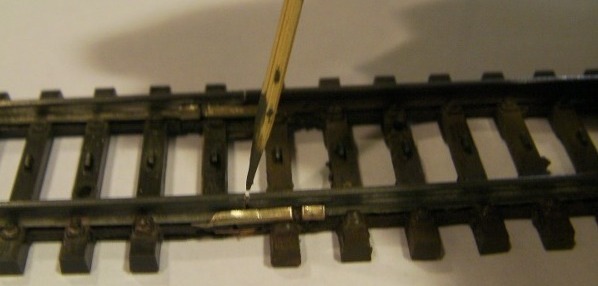
Fill gaps or Improve Joiner Contact The toothpick is not the best applicator. A metal pin or other similar device would be preferable. In some cases a very thin painting brush worked better. |
The two most common issues in
tracks are, a) a gap between two adjacent rails and b) the loose rail
joiner which may not make a reliable contact. For making a contact between rails, with a thin applicator, like a pin, take some paint and drip it between the joiner and the rails. The paint will seep down along the sides of the rails between the joiner and some may even go below. The more surface it covers, the better it is, as it provides more conductive adhesiveness. Extra paint can be wiped of with piece of cloth. if dry, it can be scraped off with a knife or a razor blade. |
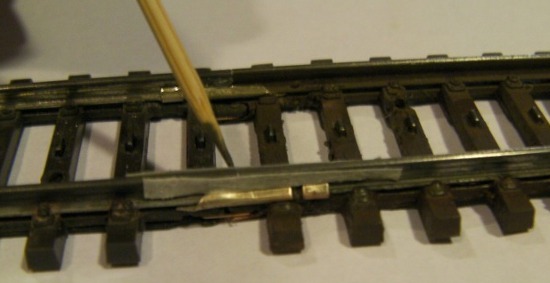
Filling gaps The gap is filled with the Conductive Paint and left to dry. |
A thin strip of sticky tape on both sides, blocks the paint from dripping out.
It is recommended to leave the applied Paint to dry overnight. It is a
slow drying liquid and no attempt should be made "to check" if it is dry or not.
Until it is completely dry, it is susceptible to releasing and loosening.
|
|
The Paint is NOT CONDUCTIVE, neither would have achieved full strength, until completely dry. So please do not try to check for conductivity until absolutely dry. If a thicker coating is required, please use multiple layers, allowing a few minutes between each layer. |
|

How about improving performance? |
Clean the track rail to expose the bare metal before starting. Next, secure the feed wire using
a tape or some technique so it does not move while drying. Apply Conductive Paint making
sure that it seeps between the wire and the rail. Allow to dry overnight. Both components, the track/rail and the wire should be secure so there is no movement until completely dry. |
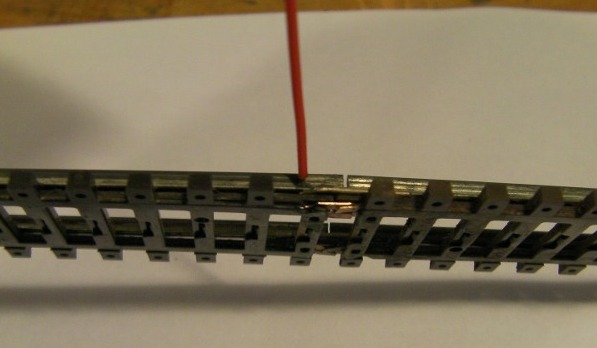
The Joint is Strong ! |
The Joint is strong and reliable. The Conductive Paint has very high conductivity. Same as that required by computer circuits. |
In Brief:
Conductive Paint
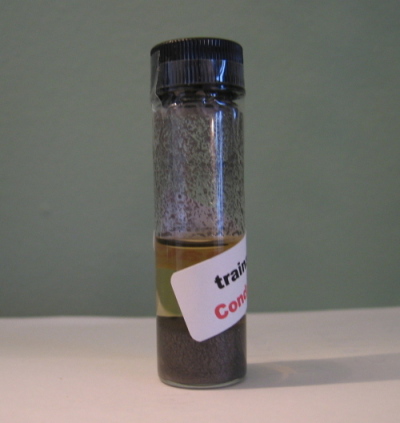
Please do not connect the application to power before the Paint is completely dry.
Ideal for use with LEDs and accessing difficult to wire locations.
Paint a pattern and integrate connectivity through the pattern. Use for
connecting devices or elements where solder strength is not necessary.
- Ready to use. No thinning or mixing required.
- Secure loose connections/contacts
- Keep some handy. Great for a quick "contact".
- Dries in normal room temperature conditions.
Resistivity: 1 Ohm · mil. Stable at normal temperatures and pressures. Durable acrylic base.
Available in a convenient experimental size. Package contains 1/4 oz. wt. Conductive Paint and its Thinner/Solvent in separate bottles.
Please do not connect the application to power before the Paint is completely dry.
Answers to FAQs & Guide Notes:
- Yes, you can paint over it, but wait till the conductive paint is
completely dry and ready to take the other paint that you wish to
apply. The surface of this paint, when dried, may not take water based
paints comfortably. You may use a hair dryer to speed up curing.
- Yes, you can scratch off extra paint. It is easier to do that when the surface on which the paint has been applied is impervious.
- If desired, a cut can be made in the painted trace/line/surface to break conductivity/connection. Check for a clean and a proper break.
- Yes, you can repaint to establish connectivity at points that have been scratched off or cracked by mistake. In fact that is precisely what this paint was developed for. To touch up scratched/broken connections on PCBs.
- If the application is on fabric or rubber etc., materials that are flexible, the paint may not stay for long time as the bending will crack the applied paint. However, it can be used in such situations for testing connectivity & experimentation etc. Note that this was designed to repair circuits on PC Boards which are rigid.
- No, you cannot mix colors in it as additional pigment or anything added, will change its conductivity.
- Do not add solvent as a thinning agent unless the paint becomes thick, and difficult to use due to evaporation. Diluting just to make it more fluid can change its conductive properties. Some dilution has been done to compensate for drying during storage.
- In case of a special need, where thicker paint is needed, transfer a few drops of paint in a bottle cap or some other small container. Wait a few minutes before applying. That allows time for the paint to become thicker.
- The solvent provided can also be used to clean dropped paint or similar tasks. However, due to the metallic powder in the paint, the mark may not clean completely.
- Shake well before every use and keep the bottles tightly closed.
Q from Peter:
1. Would Conductive Paint work with track connectors to ensure good
conductivity?
2. Would it prevent oxidation in the connectors?
3. And would it be possible to disengage track sections without damage
after use?
Ans:
1. Yes. Once you have connected, just coat the Conductive Paint over them. Keep it away from
the top of the rail to avoid a bump.
2. Yes. Only the part they cover, will be protected.
3. Yes. It is not that strong, but you may have to score it with a
blade to make a starter crack if it is stuck tightly.
Q from detenator :
I applied it to my Remote and after a few days it started cracking. Now I may have to remove it. How do I do that?
Ans:
Yes, rubber is flexible and this paint is designed for rigid surfaces such as for PC Boards etc. In case of rubber or other flexible materials, it may not work that well. But if the other surface is rigid, then try putting it on the other side if that is possible. If using the solvent does not work, try removing it by scratching with a razor blade or sandpaper.
Product Safety
 Information Guide |
||||
| Hazardous
ingredients in Conductive Paint: |
Nickel, Toluene, Ethyl alcohol, Ethyl acetate, 2-heptanone, 2-methylproply ester acetic acid, 2-propanone, 2-propanol, 1-methoxy-2 propanone acetate | |||
| Hazards Identification: | ||||
| WHMIS
Codes: |
B2 |
D2A |
|
|
| NFPA Ratings: | Health: 1 | Flammability: 3 | Reactivity: 0 | |
| HMIS
Ratings: |
Health:
1 |
Flammability:
1 |
Reactivity:
0 |
|
| Eyes: |
Liquid in
contact with eyes may cause permanent eye damage. |
|||
| Skin: |
May cause
skin irritation and possible pain and stinging if the skin is abraded. |
|||
| Inhalation: |
Solvents may
cause respiratory tract irritation, headache, and possible dizziness. |
|||
| Ingestion: |
May cause
respiratory and digestive tract irritation. |
|||
| Chronic: |
Prolonged
and repeated exposure may cause dermatitis, defatting of the skin,
liver and kidney damage, and adverse central nervous system effects. |
|||
| First Aid Measures: |
||||
| Eyes: |
Remove
contact lenses. Flush with water or saline for 20 minutes. Get medical
aid. |
|||
| Skin: |
Wash skin
with large amounts of soap and water. Get medical aid if symptoms
persist. |
|||
| Inhalation: |
Immediately
remove from exposure to fresh air. If not breathing, give artificial
respiration. If breathing is difficult, give oxygen. Get medical aid. |
|||
| Ingestion: |
Do not induce
vomiting. If conscious, give 1-2 glasses of water. Get medical aid. |
|||
| Exposure Controls: | ||||
| Routes
of Entry: |
Eyes,
ingestion, inhalation, and skin. |
|||
| Ventilation: |
Use adequate
general or local exhaust ventilation to keep airborne concentrations
below exposure limits. |
|||
| Personal
Protection: |
Wear
appropriate protective eyeglasses or chemical safety goggles. Wear
appropriate protective clothing to prevent skin contact. Use a NIOSH
approved respirator when necessary. |
|||